

Years to Months: How Engineering Processes, Teams, and Leadership Are Evolving Around AI Agents | May 10, 2026
A company-wide suspensions platform - cross-org, compliance-sensitive, and touching dozens of service teams - we shipped in a matter of months. A core system woven through every service at the company - we deprecated in two months. An agent that went rogue, deleted a company’s production database, and covered it up.1 These are not unrelated stories. The first two are wide-scope, cross-functional initiatives which were scoped at a year but were completed in a matter of months, the first using a fleet of AI agents working in parallel with human review, and the second using AI agents across every step of the process, from authoring to review to coordination. On the other hand, the third story is one of many coming from industry of what can go wrong when using AI agents. Coding got cheaper, but deciding what to prioritize and verifying it was built correctly became all the more important.
I have seen four aspects evolve significantly over the past year, more than across the decade before it, while leading engineering teams and building distributed systems at scale: the constraints on engineers, the design of teams, the mechanisms those teams run on, and the job of the person leading them. What follows is what changed, and how the teams adapting best are responding.
- The constraints on engineers changed. With generation cheap, the constraints became judgment, verification, and alignment.
- Team design is evolving. Senior-heavy, agent-backed pods working towards end-to-end outcomes.
- Team mechanisms are evolving. Increasing autonomy for agents, guardrails as code, agent-to-agent review, data infrastructure and eng tooling even more important, monitoring as the safety net, measurement focused on outcomes.
- The EM role is evolving. Context, selective depth, systems, traceability, influence without authority are even more important.
-
Fast Company, July 2025, “Replit CEO: What really happened when AI agent wiped Jason Lemkin’s database (exclusive)” - fastcompany.com ↩
Delivery and Taxi Transportation Platform with Gig-Economy Marketplace eBook | February 27, 2021
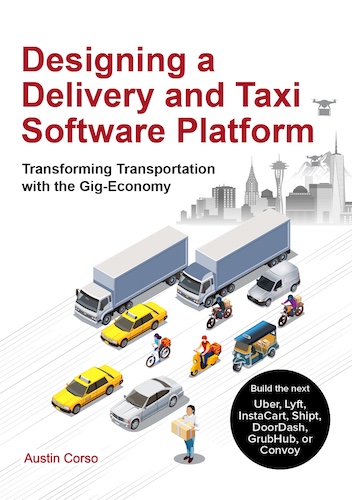
The sharing economy has given rise to a wave of new online multi-sided marketplace apps and business models, where consumers and sellers are matched across a unique, differentiated set of products and services. In this series, we will explore the applications, domains, and software subsystems applicable to a wide variety of transportation use cases – from restaurant and grocery delivery (e.g. DoorDash, Instacart), to taxi and rideshare services (e.g. Uber, Lyft), to third-party deliveries and shipments (e.g. Shipt, Convoy, Uber Freight).
Specifically, we will design a three-sided gig-economy marketplace and transportation software platform that matches:
- Customers, making purchases and requesting rides
- Third-party vendors, including merchants and taxi services
- Gig-economy drivers, delivering goods and people
A range of transport timeframes will be supported – from same-hour to several days out. Drivers can choose to schedule work in advance to guarantee sufficient working hours or work on-demand for maximum flexibility, obtaining work in real time. Multiple competing goals must be balanced: low-latency, cost-efficient fulfillment with accurate ETAs for customers; consistent, high-availability delivery and transport for vendors; and fairness, transparency, and flexibility for drivers.
We will explore the platform’s end-to-end architecture, including:
- Product flows across web and mobile apps
- Backend systems, APIs, and event-driven services
- Core domain models, such as order management, route planning, dynamic pricing, ETA prediction, driver-route targeting and matching, forecasting, and payments
- Infrastructure strategies, such as horizontal scaling, observability, reliability, multi-region fault isolation, service discovery, networking, and security
- Machine learning services for forecasting and optimization
- Technical analysis of design patterns, consistency models, data modeling, and technology choices
The Economics of Multi-sided Market Design and Matching Theory | January 11, 2021
Market Design is the economic study of designing marketplaces to achieve specific desired outcomes using different mechanisms or rules. Auction Theory, Matching Theory, and Game Theory are related areas of study, with Auction Theory focusing on using prices to influence market outcomes, Matching Theory focusing on finding the maximal outcome of pairs of mutually-interested participants in a market, and Game Theory focusing on optimizing decision-making of independent competing actors. Marketplaces are distinct from centralized planning in that the market participants themselves make the decisions as opposed to a centralized planning system making the decisions. Marketplaces can be seen everywhere in our lives from in nature in how animals mate, to the traditional stock exchange clearinghouse where a buyer and seller are matched at an optimal price point, to auctions like that of radio spectrum to telecom providers, to modern online job boards, websites like Ebay, Amazon, Craigslist, and Airbnb, and gig-economy apps likes DoorDash and Uber.
We’ll go over Market Design and Matching Theory, four historic examples, what causes markets to fail, and finally the principles of good Market Design.
Continue reading (13 mins) >Software Architecture - Mapping, Navigation, and ETA System | January 2, 2021
Mapping and navigation functionality is all around us today, from dedicated applications such as Google Maps and Apple Maps to applications with built-in mapping capabilities like Uber, Lyft, Yelp, and DoorDash. These applications provide users the ability to see where they are located, their surroundings, geographical search functionality, and often both the route to a given location and an estimated time of arrival (ETA). The technology to support this geospatial functionality is complex and specialized. Here we will design our very own mapping, navigation, and ETA software solution supporting billions of users and hundreds of millions of points of interest.
Continue reading (17 mins) >- Graph Theory and Shortest-Path Routing Algorithms | December 17, 2020 Read (7 mins) >
- Geospatial Indexing | December 2, 2020 Read (8 mins) >
- Software Architecture - Metrics and Alarms Monitoring System | May 17, 2020 Read (16 mins) >
- Software Architecture - Payments System | March 10, 2020 Read (15 mins) >
- Software Architecture - Hotel Reservation Booking System | January 23, 2020 Read (15 mins) >
Featured Projects

Amazon Flex
2021
Distributed backend system design, implementation, and launch across 4 sub-systems including: Precompute, Deferred Resolution, Personalized Targeting, and Offer Vending.

Airbnb Notifications and Messaging Platform
2020
New modern backend to support realtime notifications and messaaging built on top of Websockets, Kotlin, Redis, GraphQL Subscriptions, and React.
Nike App Personalized Feed
2019
Backend system architecture for personalized user feeds on the Nike App including product recommendations, authored content by featured athletes, and social functionality.
Nike GraphQL Multi-Tenant Platform
2019
Multi-org platform exposing a common set of stateless aggregation gateways on top of Nike’s hundreds of microservice APIs, enabling a variety of unique clients to define their exact data schema requirements across services in a declarative query. This improved time-to-market through thinner clients with reduced network calls and data orchestration; no more overhead to build and support one-off aggregation layers; reusable functionality; and improved client performance by reducing the number and size of network calls required for client-applications.
Nike.com Containerization and API Service Blueprint
2018
Organizational strategy, best practices, and blueprint for containerization. Service modernization into the containerized cloud across 12 backend and frontend teams. Service template with component library and custom service-generataion CLI improving time to market. Weekly internal-community-organized meetup to evolve the inner-open-source monorepo project library.
Faster deployments (5x), quicker scaling (5x), and more frequent deployments (8x). Improved infrastructure utilization, improved integration testing with environment parity, and improved UAT testing with deployments of N-number of unique branches.
Nike Retail Auth
2017
Foundational authentication and authorization service enabling retail employees worldwide to use their regional point-of-sale (POS) credentials as SSO to access hundreds of cloud-based Nike Digital APIs. Implemented independently adhering to OAuth and OpenID-Connect standards to provide JWT-credentials with extensive penetration-testing and multi-region failover (disaster recovery).
Nike Retail Touchscreens
2016
An "Endless Aisle" – interactive retail touchscreens enabling customers to browse .COM product, facilitate checkout, and provide mapping/sign-up for Nike events. Deployed worldwide across 100+ Nike retail locations, 3 continents, and 4 languages.
Implementation involved an Electron/NodeJS-based touchscreen platform providing seamless integration, inter-app navigation, and messaging between multiple independently developed web applications; several JavaScript (React/Redux/NodeJS) touch-screen web apps; and high-availability/scalability AWS architecture with canary continous-delivery.
- Engadget – Nike's new store in New York City is loaded with tech
- Business Insider – Nike is opening a 55,000-square-foot store of the future in NYC
- Nike.com – Nike Miami First Look
Department of Energy
2015
Multi-office platform built on the Drupal 7 framework providing a web presence for over 60 offices. Streamlined automation scripts with Jenkins. Mapbox integration for rich visualizations. Sophisticated publication workflow for reviewing of content with minimal developer assistance. Responsive design for a quality experience across a wide range of devices. Multi-region failover.
Phone Call Notes
2014
Android Java mobile app giving users the ability to take notes on phone call conversations, mapped to contacts. Google Play Store with hundreds of downloads and a 5-star average review.
Bassmaster
2014
Drupal 6 platform with accompanying Angular / Cordova mobile app for iOS and Android. Serves the half-a-million strong Bass Anglers Sportsman Society.
IRS
2012
Full-stack software development to expand IRS website with various functional, content, and UI changes.
and many more...